Which of the Following Halogens Would Have Stronger Intermolecular Forces
Well the halogens have dispersion forces as the only intermolecular force of attraction. Solids may be crystalline.
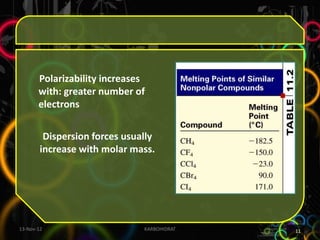
Intermolecular Forces Gaya Antarmolekul
Br 2 is a liquid and I 2 is a solid reflecting stronger attractive forces.

. The boiling points of the halogens increase in the order F2. Why should iodine be a solid. Complete the balanced chemical reaction for the following weak base with a strong acid.
Solids have strong intermolecular forces. As written all of these halogens are bimolecular and they are respectively room temperature SOLID GAS and LIQUID And so tentatively we would suggest that diiodine has the strongest intermolecular forceand NOTE we speak of the force between molecules not the INTRAMOLECULAR force ie. Trends in observed melting and boiling points for the halogens clearly demonstrate this effect as seen in.
Hence ethanol would have a lower boiling point than 12-ethanediol but ethane and dimethyl ether would both have lower boiling points. Larger molecules have larger electron clouds so you can expect the halogen with the larger diatomic molecule to exhibit the strongest London dispersion forces. Ion-dipole forces are the strongest of the intermolecular forces.
Overcome the intermolecular forces The stronger the intermolecular force the more energy heat is required to undergo a phase change from solid to liquid to gas In the table above you can see that as the LDF increase with increasing molecular weight more energy is required to melt solidliquid and boil liquid gas the halogen. The boiling point of water in the Carpathian Mountains is less than 100 C because of lower atmospheric pressure which results in reduced intermolecular forces so it would take a longer time to boil the egg. At room temperature the halogens with.
Volume close contact between atoms and molecules high density compared to gases. F 2 and Cl 2 are gases at room temperature reflecting weaker attractive forces. Question 1 0 1 pts Which of the following halogens would have stronger intermolecular forces.
The bond strengthfor which the order is inverted. The only attractive force for nonpolar. Br Cl I 2 2 2 Question 2 1 1.
The molecules become larger. As the molecule X_2 gets bigger and the electron cloud correspondingly gets bigger with greater Z there should be a greater force of intermolecular interaction as the electron becomes more polarizable. Strengths of H-bonds are typically between 13 and 40 kJmole.
Of the halogens increase going down group 7. Click hereto get an answer to your question Viscosity of a liquid arises due to strong intermolecular forces existing between the molecules. In this case write the resulting acid and.
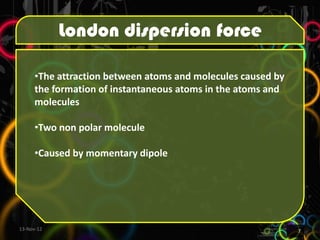
London Dispersion Forces induced dipole forces. Name the intermolecular forces existing in the following liquids. This is why at room temperature iodine which has the largest molecule is a solid bromine which is the next in line in terms of size is a liquid and fluorine and chlorine the smallest of the molecules are.
B The boiling point of water is always 100 C regardless of elevation so it would take the same amount of time to boil the egg. A The boiling point of water in the Carpathian Mountains is greater than 100 C because of lower atmospheric pressure which results in increased intermolecular forces so it would take less time to boil the egg. View Homework 3docx from CHEM 1806 at Barton Community College.
Stronger the intermolecular forces greater is the viscosity. You just studied 19 terms. This is because going down group 7.
And this is manifested by. Which of the following halogens would have the highest melting point. Is an exceptionally strong dipole-dipole force one of the three most electronegative elements F O or N must be covalently bonded to a hydrogen such as HF H2O NH3 CH3OH and CH3NH2.
As hydrogen bonding is usually the strongest of the intermolecular forces one would expect the boiling points of these compounds to correlate with hydrogen bonding interactions present. Based only on their intermolecular forces which of the following pairs of molecules would be soluble in one another. Larger and heavier atoms and molecules exhibit stronger dispersion forces than do smaller and lighter atoms and molecules.
Liquids possess weak intermolecular forces. Hydrogen bonding is a specific term for a particularly strong dipole-dipole interaction between a hydrogen atom and a very electronegative atom oxygen fluorine or nitrogen.

Use The Information And Data Given Below To Answer The Question A To C Stronger Intermolecular Forces Result In Higher Boiling Point Strength Of London Forces Increases With The Number Of Electrons

Intermolecular Forces
12 6 Types Of Intermolecular Forces Dispersion Dipole Dipole Hydrogen Bonding And Ion Dipole Chemistry Libretexts
Cwgocroo Kq1om

Imf Practice

Intermolecular Forces Ppt Download

Types Of Intermolecular Forces 4 3 1 Ib Dp Chemistry Hl Revision Notes 2016 Save My Exams
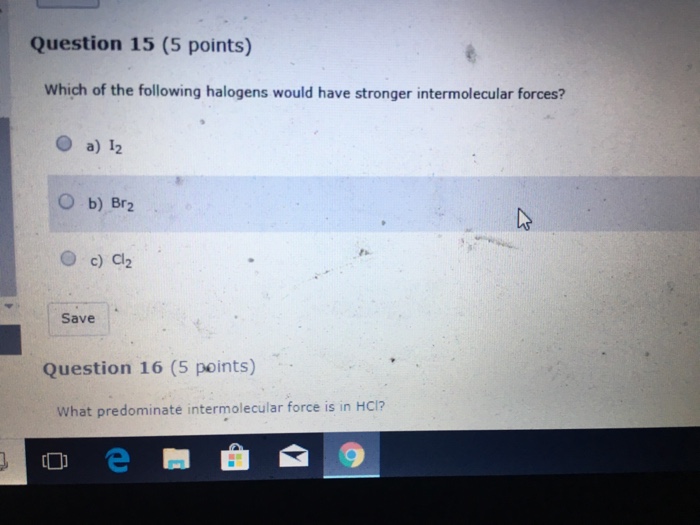
Solved Question 15 5 Points Which Of The Following Chegg Com
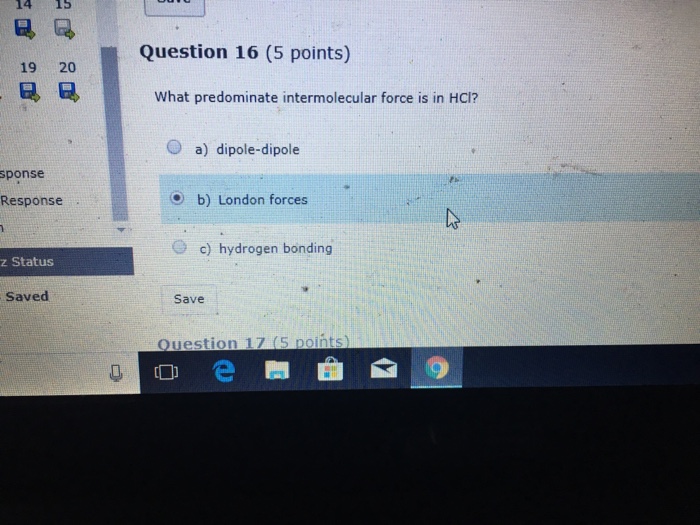
Solved Question 15 5 Points Which Of The Following Chegg Com

Organic Chemistry Science Educational School Posters Organic Chemistry Chemistry Classroom Teaching Chemistry

States Of Matter Cbse Notes For Class 11 Chemistry Learn Cbse 11thchemistrynotes Statesofmatterclass11 11th Chemistry Chemistry Notes Chemistry
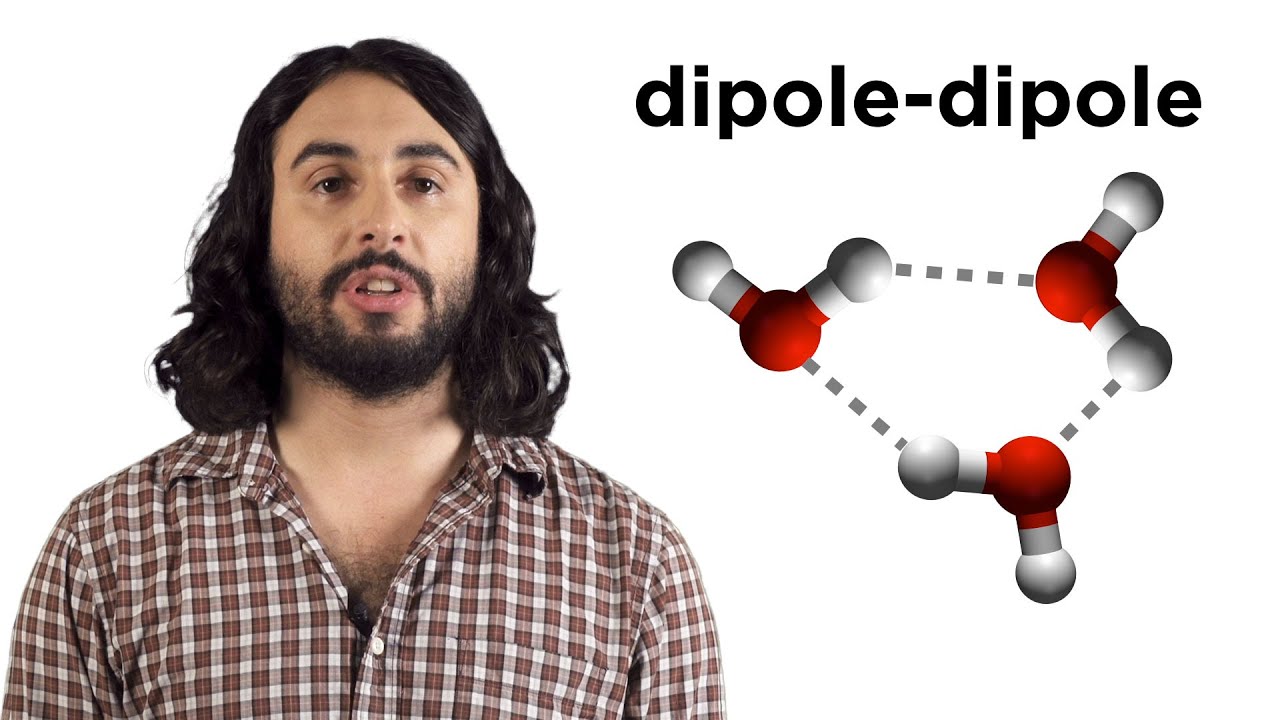
Intermolecular Forces And Boiling Points Youtube
Cwgocroo Kq1om
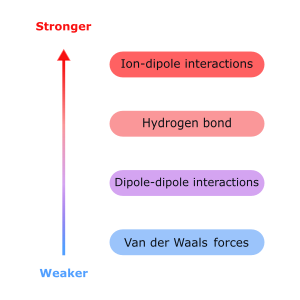
Strength Of Intermolecular Forces Psiberg
Chemical Bonding And Molecular Structure Cbse Notes For Class 11 Chemistry 8 11th Chemistry Chemistry Chemistry Notes

The P Block Elements Cbse Notes For Class 11 Chemistry Learn Cbse 11thchemistrynotes Thep Blockelementscla 11th Chemistry Chemistry 11th Chemistry Notes

Organic Chemistry Some Basic Principles And Techniques Cbse Notes For Class 11 Chemistry Learn Cbse Chemistry Notes 11th Chemistry Notes Organic Chemistry

The S Block Elements Cbse Notes For Class 11 Chemistry Learn Cbse 11thchemistrynotes Thes Blockeleme 11th Chemistry Notes Chemistry Notes 11th Chemistry
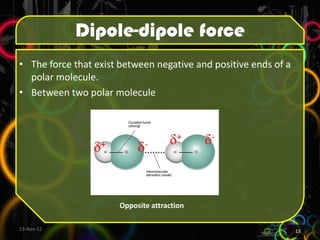
Intermolecular Forces Gaya Antarmolekul


Comments
Post a Comment